How NVMe Cache Mesh Topology Kills P99 Latency Spikes That S3 Introduces
Local NVMe cache eliminates S3's unpredictable slowdowns for hot analytics data.

An NVMe cache mesh removes S3-induced P99 latency spikes by keeping object storage out of the read path for hot data. For managed analytics, the decisive question is whether warm queries run entirely against RAM or NVMe. That guarantee has a boundary, because cold reads and cache warm-up can still reach S3.
Why S3's latency problem is structural, not incidental
A team first notices a query that is oddly slow, even though no outage alert has fired. The query eventually finishes, so the incident looks like noise. Yet the delay can be the predictable result of S3 returning HTTP 503 Slow Down responses and leaving the layer above storage to retry. Nothing has to fail outright for the user to wait. That gap between successful completion and timely completion is where P99, the tail of query latency, becomes revealing.
The limit sits below the fleet of clients. S3 enforces rate limits at its internal partitions, so adding clients can concentrate more requests against the same constrained partition. AWS documentation says requests against a small number of objects might receive slowdown responses when the rate stays above 5,000 requests per second. More compute does not remove that storage constraint. Nor can client tuning eliminate the round-trip time of a successful request, which exists before throttling starts.
This is a mismatch between storage behavior and a workload that needs predictable response times across many concurrent reads.
Three compounding mechanics that turn S3 slowness into P99 spikes
Consider a real-time dashboard reading many row-group files from a time-partitioned table. Its query fans out across dozens or hundreds of objects, with much of the work aimed at the newest data. Those objects are also among the most frequently written. Each read has a network wait, each connection has a throughput cap, and any throttled request starts a retry cycle. The query can therefore spend much longer waiting for its slow legs than its average read time suggests.
Three mechanics compound the delay. Exponential backoff can make a single throttled request take several seconds to resolve. AWS documentation notes that S3 scales to a new request rate gradually, so requests can receive 503s while internal capacity catches up even when the application appears to be within documented limits. Per-connection throughput caps then make more connections the route to greater throughput. But those connections also increase pressure on the same hot objects.
The third mechanic is present even without contention. AWS documentation describes typical small-object latency of roughly 100 to 200 milliseconds, which each GET must pay independently. Parallel reads expose more query legs to slow responses and backoff. Columnar access patterns sharpen the effect by directing concurrent queries toward recent partitions. The tail reflects the interaction of these mechanics.
Why prefix sharding only solves half the problem
Prefix sharding has real value for throughput. Spreading objects across prefixes gives requests more room to run rather than concentrating them against one hot partition. AWS documentation says reads can reach tens of thousands of requests per second in total when spread across more prefixes. For a workload constrained by request volume, that is a useful change. It can reduce the concentration that produces throttling.
But what happens to an otherwise fast, unthrottled GET? It still crosses the network to object storage, so spreading requests out cannot remove its round-trip floor. A lightly loaded prefix does not turn S3 into local storage.
That distinction separates a throughput improvement from a complete P99 solution. A customer-facing dashboard can have ample aggregate read capacity and still miss its response-time target because its query depends on object-store reads. Agent workloads extend the same problem, since a single task can generate bursts of sub-queries as it explores a schema and checks results. Sharding distributes that burst but does not change the latency of the individual reads.
What the break-even math says about when a local cache beats S3 access entirely
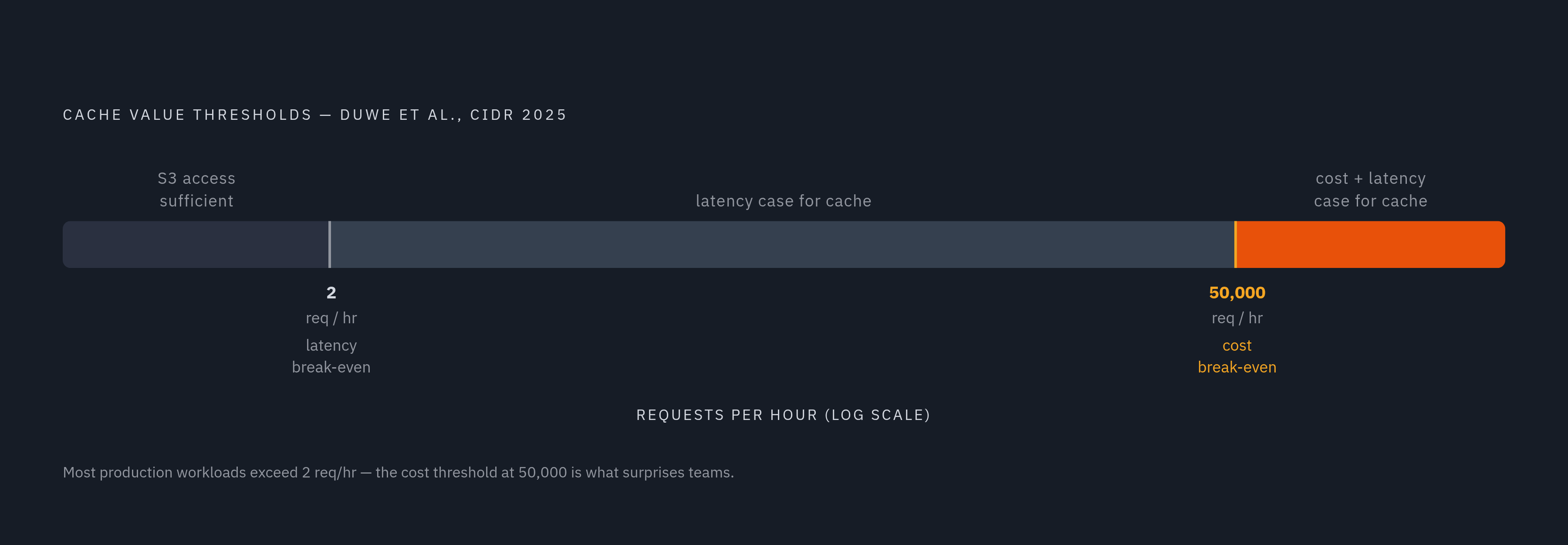
Duwe et al. derive a break-even point of roughly 50,000 requests per hour in their CIDR 2025 paper, The Five-Minute Rule for the Cloud: Caching in Analytics Systems. In that model, direct S3 access and an on-node NVMe cache become cost-equivalent at that rate. Above it, the cache wins on cost as well as latency. The paper also gives a much lower threshold for latency-sensitive workloads, at two requests per hour. These thresholds answer different questions, one about request economics and the other about the value of avoiding a slow read.
Object stores charge per request, while compute instances with locally attached storage have a flat hourly cost regardless of how much data is read. The cache earns its place through reuse. The paper also identifies more predictable tail latency as a property of local storage.
A single customer-facing dashboard can reach the higher threshold. Concurrent analytics, large observability workloads, and repeated agent exploration make reuse an ordinary workload property. Under the model’s conditions, a local cache sets the baseline for cost as well as offering more speed. The distributed design then has to preserve that advantage as the working set grows.
How NVMe's latency profile makes it the right material for the hot-data layer
NVMe provides more than a faster average read. Its queue architecture lets it handle concurrent work without forcing that work through SATA’s single queue and small command limit. NVMe supports thousands of parallel queues, allowing CPU cores to submit work independently. Under concurrent analytics load, that difference limits the serialization that can turn busy periods into long waits. Tail latency depends on how requests queue.
The software path also contributes to that behavior. SATA has more CPU overhead per I/O operation, while NVMe removes several software layers and reduces the work required for each operation. That leaves less overhead competing with query execution when many clients arrive together. In a memory-tiered cache, RAM serves the hottest data at sub-millisecond P99. NVMe holds the tier below it, keeping queries that the cache covers within analytics latency budgets without having to keep the whole working set in memory.
S3 Express One Zone narrows the object-storage latency gap. It does not remove the architectural distinction between accessing object storage and reading data already held in the hot tier. For predictable P99, the relevant comparison is therefore not only between faster and slower storage products. It is between a query that must make an object-store request and one that has no such request to wait for.
How a cache-mesh topology extends NVMe's latency advantage across nodes without losing it
A cache mesh routes hot reads to nodes holding data on NVMe. S3 retains its role as durable storage, including replication and the long-term holding of cold data. A first access can pull data into the cache. Later queries that read the data now in the cache use the hot path directly. The separation is topological, because hot and cold I/O do not share the same required storage trip.
NVMe-over-Fabrics can add only a few microseconds compared with local NVMe, leaving that access well below S3’s roughly 100 to 200 millisecond floor. But low transport overhead alone does not guarantee stable P99. The mesh must also prevent queue buildup, retransmits, and noisy-neighbor effects from spreading across tenants as throughput rises.
A distributed cache that repeatedly falls back to S3 for hot queries has not removed the source of their latency spikes. A mesh that keeps those queries on its warm path can keep P99 stable as the amount of data grows, as long as its capacity and isolation hold. Separating compute from storage also permits isolated, read-only compute for agents over shared data, without requiring their bursts to return to object storage.
Why AI agents are a stress test this architecture was always going to face
An agent can explore a schema, issue parallel sub-queries, and check its own results within one task. Those reads often target the same time window or related data. The resulting burst concentrates requests on precisely the hot objects most exposed to S3 throttling. Agent access through a dedicated protocol supplies a concrete protocol layer, but the storage problem comes from the access pattern beneath it.
Pricing creates a second source of pressure. With per-query charging, the agent’s checks add cost whether or not they add value to the business. A cache mesh removes S3’s throttle trigger for resident hot data, while compute-hour pricing avoids accumulating per-query penalties. Neither should be inferred automatically from the presence of the other.
Agents need full query logging, isolated read-only compute that blocks production writes, and sandboxed branches where they can explore schemas against real data. Structured commands to describe, validate, and deploy schemas and pipelines as code reduce the ad-hoc query surface. That makes agent behavior more predictable and auditable while the storage topology handles its concurrency.
What the architecture looks like under stress — cache warm-up, node drain, and rebuild
What happens when the required data is no longer cached? After a node drain or rebuild, cache misses can fall back to S3, bringing its round-trip floor and throttle behavior back into the read path. Warm-up is a real interval of exposure. A credible design makes that interval bounded and predictable rather than claiming that every production read always avoids object storage. Cold access remains a boundary of the guarantee.
A well-designed mesh contains noisy-neighbor effects and retransmit problems at the draining node. To track how the mesh handles that stress, monitoring must cover cache hit rate, node health, and warm-up progress, as well as query latency and ingestion delay. Without those signals, a slow query can again appear without an explanation.
Durability remains separate from cache availability. S3 holds the durable record, supporting point-in-time recovery and deterministic rebuilding of the cache layer. Outside the warm-up window, resident hot reads stay off S3, which is the basis for keeping their P99 stable at scale.
Schema and query design that lets the cache mesh do its job
The mesh can serve only the data it holds. Sort keys, partitioning schemes, and codec choices determine how much data a query touches, so they also shape how often the query stays within the hot tier. Partitioning by time or key dimensions and clustering on frequently filtered columns reduce scan size. Fewer objects need to be read, allowing the cache to cover more of the actual access pattern. Poor layout does the reverse, scattering reads across cold objects.
Columnar storage also calls for append-first design. It is not optimized for row-level mutations, and retrofitting that discipline onto a large dataset is expensive. The transition can temporarily spread access across more objects than a well-designed schema would normally touch. Overlong TTLs fill the hot tier with rarely queried data, while overly short ones send still-useful data to S3.
These decisions explain why the original slow query cannot be understood as a hardware issue alone. A query that repeatedly reaches cold objects opts back into the storage mechanics the mesh was built to avoid. For teams migrating to this architecture, much of the performance work therefore belongs in schema and query design. Adoption is a handled engineering project because the topology needs the right working set before it can deliver its latency advantage.