Flat Compute Pricing vs Consumption Pricing for Variable OLAP Workloads
Consumption pricing works best for bursty workloads, flat pricing for high utilization.
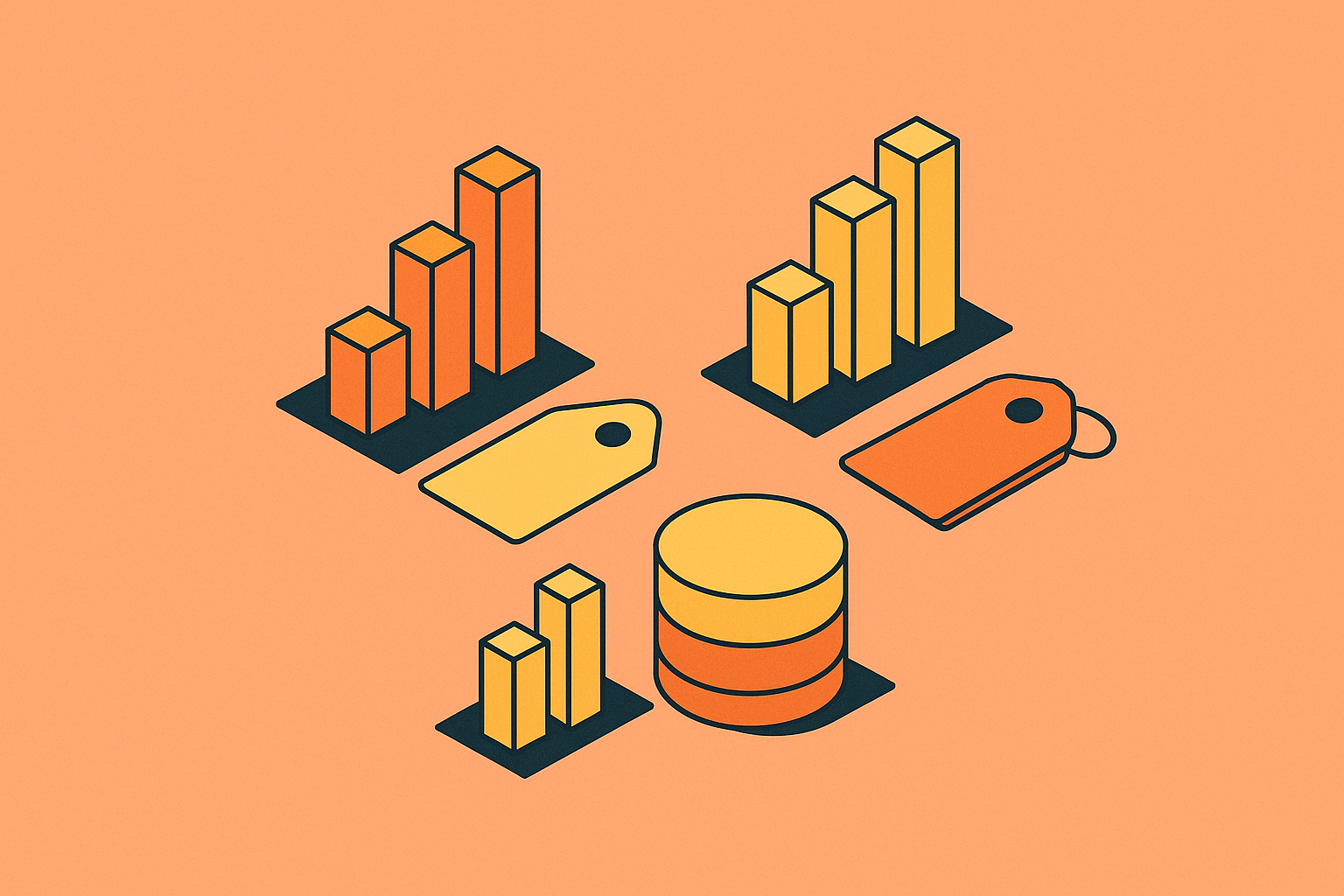
The right answer depends on three measurable things: how often a system gets queried, how much those queries vary in cost, and whether AI agents are generating traffic alongside the humans.
Pricing model choice as an engineering decision, not a vendor preference
You shouldn't pick between flat compute and consumption pricing based on which vendor's sales pitch sounds more honest. It's about matching a billing model to the actual shape of a workload. Get the match wrong, and the bill stops reflecting what the system actually does. The sections that follow test each model against those variables in turn, starting with the case for consumption pricing on its own terms.
How consumption pricing works
Consumption pricing makes sense for teams whose usage comes in bursts. A team that runs heavy queries for a few hours, then goes quiet for the rest of the day, pays only for the hours it used, and skips the waste of a server sitting idle waiting for the next job. Snowflake runs this model by charging credits only while a warehouse is active, and its auto-suspend feature stops the meter during idle stretches, so a well-run environment with predictable, bursty usage can beat any flat-rate deal on price.
Databricks applies the same idea at a finer grain. Billing runs per second of compute, so if your job finishes faster, you pay less. Tuning a pipeline to run in half the time drops the bill by roughly half too. You get a direct, immediate reward for performance work, with no contract renegotiation needed.
The honest case for consumption pricing centers on uncertainty. Early-stage teams, or any team whose workload genuinely jumps around and resists forecasting, can avoid locking into capacity they might never use. A workload that's spiky, short-lived, and getting more efficient over time is the strongest fit: every optimization lowers the bill the next billing cycle, not the next contract renewal.
Where consumption pricing breaks: the governance problem at scale
What makes consumption pricing fair is also what makes it fragile. One poorly governed query, one warehouse left running past its job, can multiply a bill before any alert has time to catch it. The model rewards discipline and punishes its absence, and it has no floor to stop the damage once discipline slips.
Concretely: a Snowflake environment with warehouses running longer than needed, sized bigger than the job requires, or burning credits on features nobody asked for, can bill three to five times what an optimized deployment costs for the same work. Misconfiguration like this is the default outcome when nobody is watching closely enough, which is most of the time, on most teams.
Idle waste doesn't disappear just because auto-suspend exists. Credits lost to warehouses sitting idle between restarts still make up a real share of total credit spend across Snowflake deployments, because teams restart warehouses constantly instead of sizing them correctly in the first place. The tool to stop the waste exists. Sustaining that discipline consistently across a growing team is hard.
Long-term contracts add a second trap on top of the first. Three-year commitments buy a steep discount, but they lock the buyer into whatever usage pattern they projected at signing time. Grow faster than expected, and the overages hurt mid-contract. Grow slower, or flatten out, and the buyer sits on credits that expire unused. Either way, the contract bets on a forecast, and forecasts are the thing workload data is worst at producing.
None of this makes consumption pricing a bad idea. It describes a structural weak point: the model works as well as the governance around it, and governance erodes faster than most teams expect. There's no efficient way to tell whether a query was intentional or wasteful until the bill already reflects it, which makes the risk structural. Architecture that separates compute from query frequency, keeping hot data in a cache layer instead of routing every request through object storage, is one way to make cost predictable regardless of how often the system gets hit. ObsessionDB builds around exactly that separation, which turns the governance test into whether the architecture makes bad queries cheap by default."
Why flat compute pricing wins under steady-state, high-utilization workloads
The break-even between flat and consumption pricing is a matter of utilization math, not philosophy. When a cluster runs at high utilization for most of the day, provisioned capacity beats per-unit billing, because there's no idle time left to pay a premium for avoiding.
The idle-waste argument also holds in reverse. Self-hosted OLAP deployments waste around 60% of their cost on idle periods when instances run continuously instead of scaling down. Flip that: a team whose workload runs continuously anyway eliminates that same waste by paying flat for the capacity it's using nonstop, rather than paying a consumption premium on top of constant use.
Google's own product lineup backs this up. BigQuery Editions lets teams buy dedicated slot capacity and run queries against it without per-byte billing. Google built that option because its own customers found it was cheaper under high-frequency workloads. A major cloud vendor offering a flat-rate alternative to its own consumption product shows that the utilization break-even isn't theoretical, but a real market signal.
Storage architecture also hides a related cost that fans of consumption pricing often miss. A dataset scattered across thousands of small files scans the same number of bytes as a well-organized one, but it multiplies the manifest entries and the round-trips to object storage along the way. The query runs longer and burns more compute, so poor file layout raises compute costs in a way that's invisible to anyone watching the storage line item instead of the query runtime.
If your analytics workloads run continuously at sustained high utilization, you get more for your money with flat provisioned compute, and that increasingly fits any environment where agents generate traffic alongside human analysts, each probing data in real time. Sizing provisioned compute to match sustained utilization, rather than to match peak load, turns a variable cost into a predictable one, which matters for engineering planning as much as it matters for the finance team's forecast.
How AI agents break consumption pricing's core assumptions
Consumption pricing was built around human analysts: people who log in, run a session's worth of queries, and log off. Agentic workloads don't behave that way, and the mismatch produces cost spikes that no amount of governance discipline can reliably head off.
The billing minimum is where this gets sharp. Many warehouse platforms apply a 60-second billing minimum when a warehouse starts up. For a human running a handful of queries a day, that minimum barely registers. For an agent firing thousands of short queries a day, that same 60-second minimum can multiply the real cost several times over compared to per-second billing. Agents generate exactly the kind of short, frequent query that exposes this overhead at its worst.
When agents use MCP to query OLAP databases at high frequency, they trip the consumption meter every time they probe. An agent checking a schema costs the same meter-click as an agent running a full table scan, because the billing system can't tell the difference, and neither can the agent. Consumption pricing assumes a human is choosing when a query is worth running. Agents don't make that judgment call; they just run the next query.
The observability market shows where this trend is heading. Telemetry data has more than tripled at a majority of enterprises over the past year, and agentic AI workloads are projected to push that growth further within two years. That telemetry sits in the same OLAP stores the agents are querying, which compounds consumption costs on both sides of the loop at once. More agents generate more telemetry, more telemetry demands more queries, and every one of those queries meters separately under a consumption model.
What flat compute pricing for agentic workloads requires from the database
Flat pricing only solves high-frequency agent access if the database underneath it is built to support that access without choking on it. A provisioned cluster that thrashes every time an agent probes it is just broken in a different place than consumption pricing.
Three architectural requirements follow directly from that. Hot data needs to stay in memory, not get re-fetched from object storage on every single query. Agents need isolated compute, so their probing doesn't crowd out the production queries running at the same time. Every agent query needs to be logged, so you catch a runaway pattern before it eats through provisioned capacity, not after the bill arrives.
ObsessionDB was built around those three requirements specifically. Its NVMe cache mesh keeps hot data in memory, so agents never have to wait on round-trips to S3. Agents run on isolated, read-only compute over the same underlying data, so a flood of agent queries can't slow down production traffic. Every agent query gets logged in full, so teams get an audit trail instead of a guess. Sandboxed branches let agents experiment against real data without ever touching the production copy.
CHKit extends that same discipline to schema and pipeline management: structured commands let agents describe, validate, test, and deploy changes as code, so agent access runs through a defined interface rather than ad hoc queries nobody can trace back. That's what makes agent behavior reproducible, and governable, rather than a black box that happens to log its own inputs.
Pricing has to match that architecture, or the governance work goes to waste. ObsessionDB prices on compute hours rather than per query, so agents never get penalized for asking more questions. The cost of exploration becomes the cost of the capacity itself. A managed analytics service built for agentic workloads, with fully logged and sandboxed agent access priced by compute hour, removes the cost-per-query tax that makes autonomous access prohibitively expensive under per-query billing.
Full query logging matters beyond compliance. As agent counts scale from dozens to thousands, each one requesting data dozens or hundreds of times per second, an unlogged agent connected to a consumption-billed database is a liability nobody has budgeted for. Logging every query is the mechanism that turns agent cost from a surprise into a number a team can see coming.
Reading your own workload shape to pick the right model
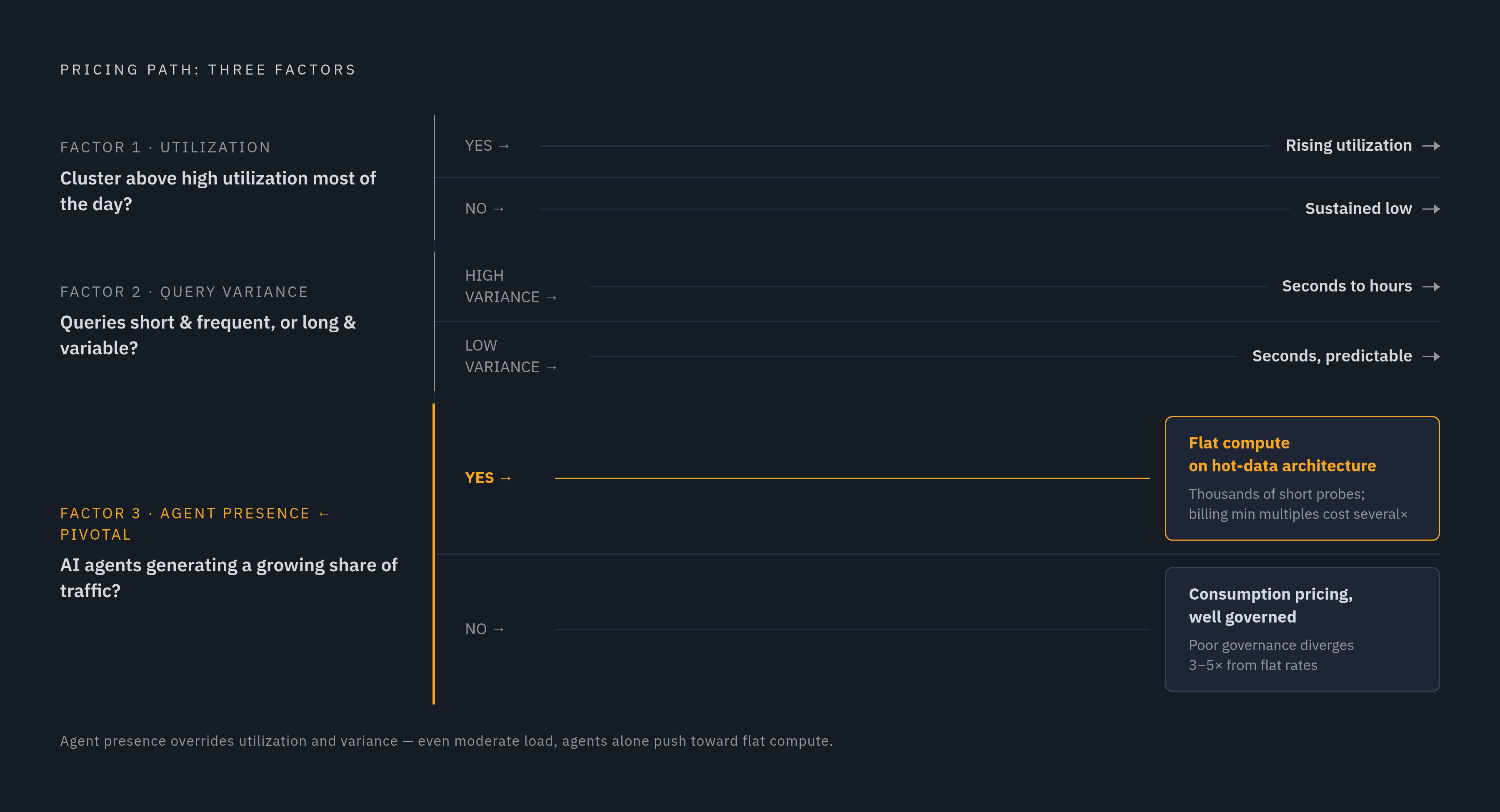
Three characteristics decide which pricing model fits a given workload, and all three can be measured or estimated before anyone signs a contract: utilization pattern, query variance, and agent presence. Walk through them in order, because they build on each other rather than standing alone.
Start with utilization. If a cluster would run above a high utilization threshold for most of the day, provisioned capacity beats consumption rates for the same compute hours. The break-even calculation needs to run on actual query duration distributions pulled from logs, not on a rough average load estimate, because averages hide the idle gaps that make consumption pricing look cheaper than it is.
Next, query variance. When individual queries vary enormously in cost, seconds for one, hours for another, you pay in proportion to what each query actually costs under consumption pricing. That's a real advantage, but it comes with a catch: billing minimums can flip the math entirely for workloads made up of short, frequent queries, which is exactly the profile agents produce.
That leads to the third factor: agent presence. Agents push the calculus toward flat compute even at moderate utilization levels, because they generate the short, frequent, exploratory queries that expose consumption billing minimums at their worst, and their traffic is hard to predict ahead of time. Flat provisioned capacity turns that unpredictability into a number that doesn't move month to month.
Consumption commitment traps are a third consideration: three-year discounts of roughly a third to half are attractive, but they lock buyers into usage forecasts that may not survive a shift to agentic workloads. If your team expects meaningful agent adoption within the next one to two years, you should weigh that trajectory before signing a multi-year deal.
The same workload-shape logic applies inside a single consumption platform, not just between flat and consumption models. Databricks' DBU rates span roughly a twenty-fold range across compute types, and teams routinely run production pipelines on interactive compute, paying three to four times what the correct job compute tier would have cost for the same work. Picking the right tier within a consumption model takes the same workload analysis as picking between flat and consumption pricing in the first place.
The three variables together put most teams in one of two clear positions. Sustained utilization, low query variance, and no agents in the loop: consumption pricing, well governed, holds up fine. Sustained or rising utilization, high query variance driven by short probing queries, and agents generating a growing share of traffic: flat compute, built on an architecture that keeps hot data close and logs every request, is the model that keeps the bill matching the work actually being done.