Agentic Query Workloads vs Human Query Workloads
Agents investigate in parallel bursts that demand separate infrastructure from human analytics.
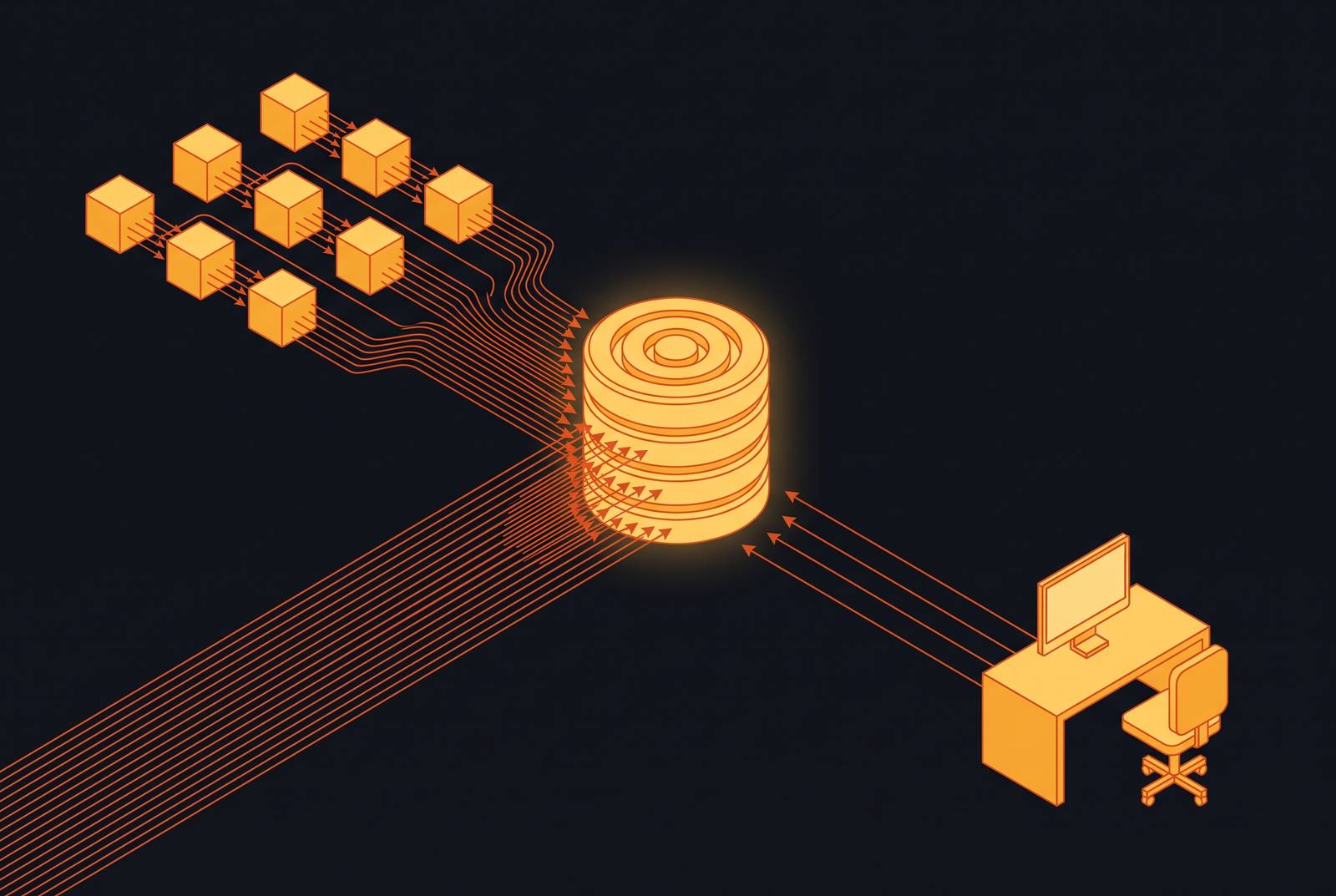
Agentic query workloads differ from human query workloads in their rhythm and size. Their parallel bursts, rapid iteration, and repeated probes demand infrastructure designed for that behavior. ObsessionDB is one option built for those needs, with isolated compute, warm data, and full query logging. Agents and analysts can share data without sharing the bottlenecks that slow each other down.
Why agent query behavior needs its own mental model
Consider an agent mid-investigation when a production dashboard goes dark. The agent is still probing, its parallel tasks are still issuing queries, and the shared query queue is backing up. The usual picture of analytics assumes someone submits a query, waits, reads the result, and then writes another. That pause gives the system breathing room that agent traffic does not reliably provide.
MotherDuck's query analysis found that humans still did more querying in January 2026, but agentic queries overtook manual queries in February, with the gap roughly doubling each month afterward. That finding describes traffic on its platform, rather than proving that every database has the same mix. It nevertheless shows that the shift is already happening. Concurrency ceilings, latency tolerances, pricing, and caching now need to account for a user whose behavior differs from the one those choices originally assumed.
The five behavioral differences that make agent workloads structurally distinct
Query volume per session is the first difference. A human analyst might ask two or three questions, while an agent investigating a revenue drop in Europe last quarter generates dozens of SQL queries on the fly. Each result can lead to another check. MotherDuck's query analysis also found roughly twice as many agent users as human users per organization on average, with larger ratios at the extremes. More users issuing more queries means concurrency ceilings calibrated to human sessions can fall far short.
Inter-query delay changes how that volume arrives. MotherDuck's query analysis found much shorter gaps between agent queries than between human queries, making agent traffic far burstier. Agents pipeline their work, generating the next query before the previous result is fully consumed, while a person would pause to read. Insufficient burst headroom can leave the agent waiting while the system scales up and leave compute idle after the burst ends.
Query size distribution changes which part of performance matters most. Agents make large requests, but their schema inspections, metadata reads, and single-column probes make their median query size smaller than a human analyst's median. MotherDuck's query analysis identifies this combination of large requests and a much greater volume of small ones. For those small requests, a multi-second minimum response time can outweigh the work needed to answer the query. The latency floor therefore becomes a rate-limiter on reasoning, even when large-query throughput looks healthy.
Schema-exploration frequency adds work that a data-only view of analytics misses. Agents repeatedly acquire context by reading table schemas and validating whether a query matches their intent. These requests belong to the investigation, even when they retrieve no business data. These requests repeat at a machine's pace, with no direct match in a usual human session. As a result, a fast data path paired with a slow catalog still leaves the agent waiting, because metadata access sits directly in its reasoning path.
Parallelism compounds the other four differences. Human analysts generally build one query at a time, while agents can send sub-agents across the same dataset simultaneously. Halo research from NUS describes workflows that fan out into retrieval-and-summarize calls over overlapping contexts, with tens to hundreds of investigations running concurrently at scale. Shared data faces concentrated multi-tenancy pressure, while workflows that also write can introduce contention even in systems optimized for reads.
How the probe-validate-refine loop changes what "accuracy" means for databases
These behaviors follow from the way agents seek a correct answer. An agent generates a candidate query, executes it, checks whether the result matches intent, and refines its approach when it does not. Schema checks, partial aggregations, and sanity probes are part of that process. A database can return a correct result for one SQL statement without resolving whether that statement supplied the information the business needed. Supporting accuracy therefore means supporting the loop that tests the connection between the two.
Research is beginning to formalize this distinction. Halo research from NUS describes repeated drafting and refinement of common SQL queries, including weekly revenue by SKU, across overlapping contexts. Optimizing each call in isolation leaves substantial redundant work. Credo research from Brown University, with a co-author from Northwestern, identifies another obstacle, namely that successful agent harnesses bury logical steps, runtime signals, execution choices, and prompt strategies in opaque imperative code. The database receives exploratory queries without an inspectable account of the larger reasoning process that generated them.
The strongest objection is that better prompting and richer context should reduce the need for all this probing. They can reduce iteration count, but they do not remove the need to validate intent against real data. MotherDuck's query analysis emphasizes investment in context because it improves accuracy and reduces token cost. That makes context quality and fast database access complements.
Why infrastructure built for human analysts fails under these patterns
The first failure is often a mismatch in scheduling: a system configured for a handful of human sessions can run substantial analytical queries yet lack room for parallel agent tasks. When those tasks arrive together, the queue grows and latency becomes hard to predict. The system has been calibrated for a different arrival pattern.
Scaling exposes the idle-vs-warm dilemma. MotherDuck's query analysis describes how scaling up for burst concurrency makes the quiet periods expensive, while scaling down loses pre-warmed data and adds latency to the next burst. Human workloads leave more time between steps, so that trade-off is easier to manage. Agents compress the same tension into much shorter intervals. Capacity and data warmth become separate concerns, even when the infrastructure treats them as one.
Other assumptions break within the request path. A multi-second latency floor may be tolerable for a large, infrequent query, but it accumulates across small probes in an agent investigation. Slow metadata access adds more waiting before the agent can even form queries for the data it needs. Where agent workflows move beyond retrieval into writes, read-optimized indexes face a different problem. Actian's Q2 2026 analysis describes a move toward write-heavy, low-latency, and hybrid memory patterns that can cause index bloat and traffic spikes.
The cost model can amplify these technical mismatches. Per-query or per-byte-scanned pricing attaches a charge to repeated exploration, even when that exploration is how the agent checks its answer. Query multipliers can therefore change costs in ways that estimates based on human sessions do not capture. The failure is that a model chosen around occasional analyst questions can make agent curiosity unexpectedly expensive.
What agent-ready data infrastructure actually requires
The behavioral differences lead to four core requirements, which are warm-data locality between bursts, a near-zero latency floor for small queries, isolated compute, and full query auditability. Warm data must stay ready for use from one probe to the next, even when each probe gets a fresh compute environment. With hot data in memory or NVMe cache, every request no longer has to go through object storage. MotherDuck's query analysis also proposes local catalog sync so exploratory catalog queries can become instant and free. Metadata deserves the same attention as the data it describes.
Isolation and auditability address a different part of the problem. Isolated, read-only compute over shared storage lets agents explore without exposing production workloads to their bursts. Every agent query must also be logged in full, rather than sampled, so teams can reconstruct an investigation or trace a bad result. Beyond those four technical needs, pricing should fit the workload's rhythm. Compute-hour pricing charges for capacity, so each added validation query comes without a separate charge.
ObsessionDB meets these needs with isolated, read-only compute over shared data, a cache-mesh architecture, and logging of every agent query. Its compute–compute separation makes isolation between agents a built-in default, so agent traffic does not slow production traffic. Each agent run gets a sandbox with its own compute over shared production data in S3. That gives the probe-validate-refine loop room to operate without touching production workloads. It is a strong fit for teams whose central concern is allowing parallel exploration while keeping production separate.
For small-query latency, the relevant detail in ObsessionDB is that its cache mesh keeps hot data in memory and reduces S3 reads to nearly zero for that data. Its flat p99 latency as data volumes grow addresses consistency as well as speed, so a growing dataset does not itself raise the latency floor. CHKit adds typed commands to describe, validate, test, and deploy schema and pipelines as code, reducing unstructured exploration. With its managed, capacity-based pricing, there is no per-query charging, but operators still have to choose how much capacity to provision for bursts of agent traffic.
Keeping agent traffic on shared analyst compute preserves a common execution pool, but leaves the concurrency and interference problems described earlier. Creating fresh compute for each query separates execution while sacrificing the benefit of pre-warmed data. Maintaining warm capacity can avoid that restart penalty, but makes idle capacity part of the cost decision. These approaches are best judged against the same requirements, rather than against a platform label or a throughput figure that says little about small probes.
MCP as the access layer connecting agents to databases
Database architecture is only part of the path, because an agent also needs a way to reach it. MCP has become the de facto standard for connecting agents to external tools, databases, and services. It replaces bespoke connections between each agent framework and each database with a standardized interface. MotherDuck's query analysis distinguishes agent and human traffic by separating MCP-server queries from UI queries. That makes the access channel part of how the workload shift is measured.
For most new agent projects, MCP is the right default, particularly for single-user and small-team workflows. Large, multi-tenant production systems with strict security requirements need more care because today's ecosystem does not have the enterprise-grade trust infrastructure they need. The gaps that have been documented include malicious code execution, remote access control risks, credential theft, and missing authentication and authorization. These are reasons to examine the controls around an integration. A standard interface on its own falls short of the trust boundary these systems need.
The database must therefore supply query-level isolation and auditability that MCP does not enforce on its own. Isolated read-only compute, full query logging, and sandboxed branches back the access layer with controls at the point where queries run. Structured tooling can also reduce unnecessary raw SQL without replacing that layer. CHKit's commands for schema description, validation, and pipeline deployment complement MCP by giving agents a more defined set of operations.
Designing for both users without penalizing either
Human analysts and agents need execution paths that respect their different behavior. Separate compute lanes keep agent bursts from degrading analyst dashboards. Warm-data caching that survives those bursts and a near-zero latency floor keep small probes from stalling investigations. Compute-hour pricing bases the cost decision on capacity.
Halo research from NUS points toward structured query plan DAGs that expose common computation across concurrent agent workflows, reducing redundancy and improving hardware use. That direction can benefit both kinds of users by lowering overall system load. The practical design posture is to treat agents as first-class database users from the start. Evaluate the burst, the smallest probe, the warm-data path, and the isolation boundary alongside how many queries the platform can finish.