Stream Processing vs Batch Processing for Analytical Workloads
Pick the model that matches your latency requirement, not the one that sounds more sophisticated.
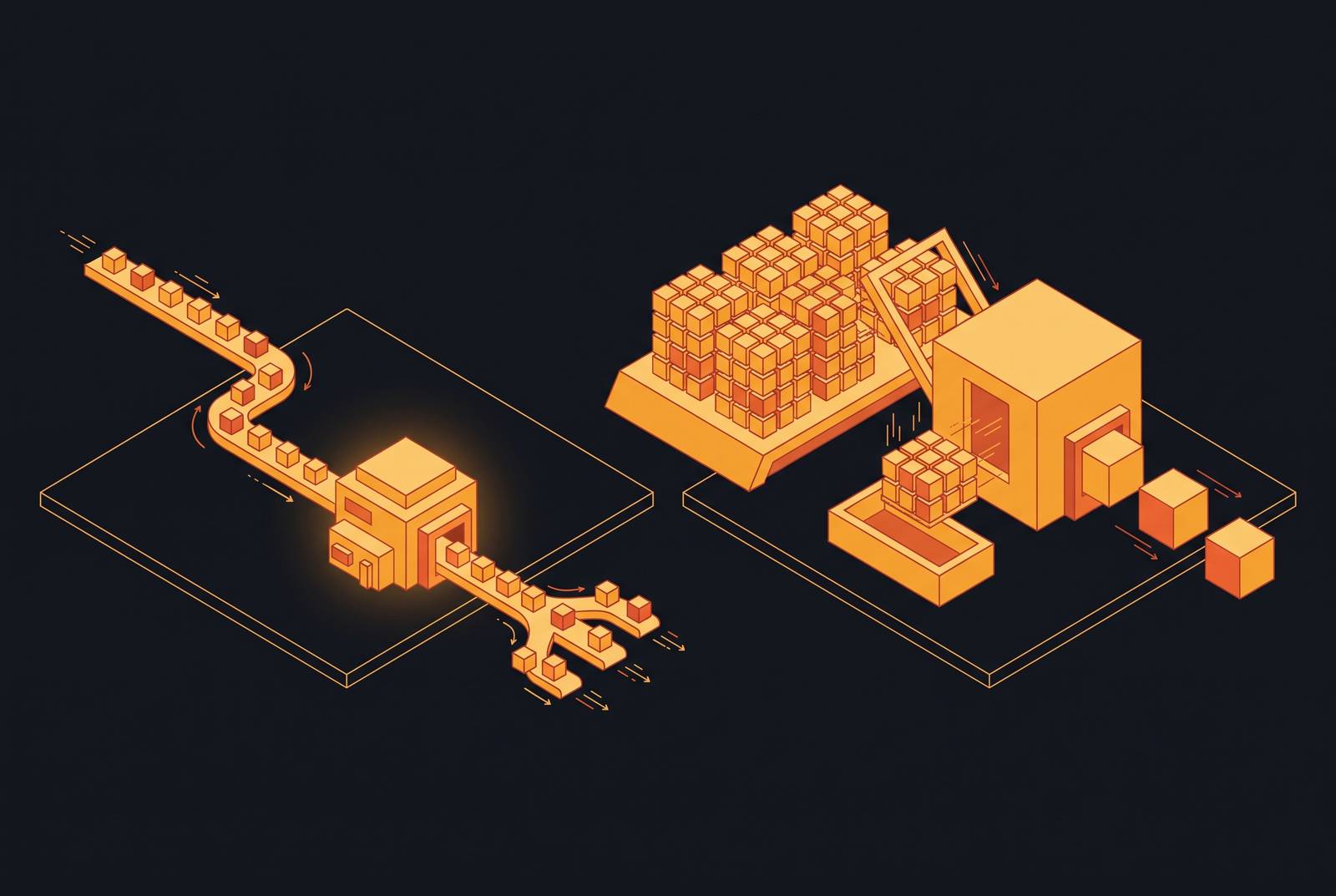
Stream processing and batch processing are two different answers to two different questions, and the question that matters is whether a given workload's latency requirement justifies the operational cost that streaming imposes. Most production systems already run both at once, so the "vs." in that framing is really a planning decision, not a philosophical contest.
The real distinction is about data shape, not speed preference. Batch operates on bounded data: a finite set collected over a window, processed as one unit, with a clear start and end. Streaming operates on unbounded data: records arriving continuously, with no natural stopping point. Every downstream difference in latency, cost, and complexity traces back to that one fact.
Treating this as a competition pushes teams toward over-engineering. The goal of this piece is to replace that instinct with a framework: three filters, applied in order, that tell an engineer which model a workload actually needs.
What each model does
Each model's properties follow directly from whether it treats input data as bounded or unbounded. That single distinction determines latency, cost structure, state management, and how easy the system is to debug.
Batch works on a schedule. A scheduler triggers a job, the job reads a source, transforms the data, writes output, and exits. Resources release when the job completes, and observability is retrospective: logs and metrics describe something that already finished. That structure gives batch several durable strengths. Vectorized operations and bulk writes make it efficient at throughput. Infrastructure only runs when the job runs, so cost tracks workload volume rather than clock time. Batch jobs are also simpler to reason about and replay, since a bounded job can simply be run again.
The costs appear on the latency side. Output is only available after the window closes, so an overnight job leaves a blind spot for anything that happens before the next run, and downstream consumers are always looking at data that is, at minimum, one cycle old.
Streaming works on an open pipe. A producer emits events, a broker like Kafka, Pulsar, or Kinesis buffers and distributes them, and a processor consumes and transforms the data continuously, pushing outputs to sinks in near-real-time. Within that model, stateless processing treats each event independently, which keeps the system simple to build and easy to scale. Stateful processing is a different animal: output depends on accumulated context, such as detecting whether the same card was used in three countries within an hour. That kind of logic requires durable state stores and checkpointing, and fault tolerance becomes critical, because losing state mid-stream means losing accuracy, not just losing a few records.
The cost is that compute and network run around the clock: the architecture typically needs a message broker, a schema registry, and a state store, the system is harder to debug because the pipeline is distributed and continuous, and reprocessing means replaying from the source.
| Dimension | Batch | Streaming | |---|---|---| | Latency | Minutes to hours | Milliseconds to seconds | | Data model | Bounded, finite | Unbounded, continuous | | Trigger | Schedule | Event arrival | | State | Rebuilt each run | Maintained continuously | | Cost model | Pay-per-run | Always-on compute | | Reprocessing | Easy, re-run the job | Harder, replay from source | | Debugging | Easier, reproducible and bounded | Harder, distributed and continuous |
The latency requirement is the first and most decisive filter
Latency is a gate to pass through. If a business process must react within seconds, streaming is mandatory no matter what it costs to run. If the process can tolerate a delay measured in hours, batch is the correct default, and reaching for streaming anyway is paying for speed nobody asked for.
Consider fraud detection. A payment needs to be flagged before it settles. The decision has to happen inline, in the seconds between authorization and completion. Batch cannot serve that use case at any price, because by the time the nightly job runs, the fraudulent transaction has already cleared. Now consider a weekly sales report that finance reviews every Monday morning. The report is just as useful either way, and the streaming version costs more every single day it sits idle between review cycles.
Whether real-time is necessary matters more than whether it is technically possible. Plenty of use cases that feel like they deserve real-time treatment are served perfectly well by data that is a few hours old. A dashboard that marketing checks twice a day does not need sub-second freshness just because the technology to provide it exists.
A handful of use cases sit clearly on the streaming side of the gate: fraud detection that has to flag a transaction before it settles, IoT anomaly response that has to react to sensor data instantly, change-data-capture pipelines replicating database changes in real time, dashboards where metrics must update within seconds, and AI agents that need fresh context to give accurate answers. A handful sit just as clearly on the batch side: historical reporting on a daily, weekly, or monthly cadence, ML model training on large historical datasets, data warehouse loading, complex ad-hoc analytics run over large data volumes, and backfill or reprocessing jobs. Apply the gate to any workload by asking what happens if the answer arrives an hour late. If the answer is "nothing breaks," the latency filter already points to batch.
How data shape and arrival pattern affect fit
Passing the latency gate toward batch does not end the analysis. The shape of the data itself, bounded or unbounded, ordered or out of order, measured in event time or processing time, constrains which model can handle it correctly without adding engineering cost nobody budgeted for.
Bounded data, like a completed day's transactions or a static dataset sitting in a file, suits batch naturally. The job knows its input size in advance and can optimize around it. Unbounded data, like a continuous event log, a sensor feed, or a CDC stream, works the other way: there is no natural end point at which a batch job could even begin, because the data never stops arriving. That pushes the architecture toward streaming or micro-batching by necessity, not preference.
Out-of-order and late-arriving events are a problem specific to streaming, one that batch rarely has to think about. Event-time windowing, supported by frameworks like Apache Flink, makes this tractable by grouping events according to when they actually happened. That mechanism works, but it adds real implementation complexity that a batch job, reading a bounded file, never has to deal with.
Stateful joins across time raise the difficulty further. Losing a state store mid-stream means losing the context that made the join meaningful in the first place, an operational risk the architecture has to plan around.
Reprocessing tips the balance back toward batch. When business logic changes, or a bug in a transformation needs retroactive correction, batch simply reruns the job against the same bounded input. The same asymmetry applies to reproducibility: regulatory filings, financial reports, and audit trails depend on the guarantee that the same input and the same code produce the same output every time, and batch delivers that guarantee by construction.
The operational complexity and cost each model carries
Latency and data shape together narrow the choice, but neither filter accounts for what a team is actually signing up to operate. Streaming's complexity and its always-on cost are not an argument against using streaming where it's needed. They are an argument against choosing it where batch would do the job just as well.
Batch infrastructure wakes up, does its work, and goes back to sleep. Resources are consumed only during execution, so cost tracks workload volume rather than the clock, and jobs can be scheduled during off-peak hours to take advantage of cheaper compute pricing. None of that infrastructure gets to clock out at the end of the job.
That asymmetry matters most at lower frequency or lower volume. A fraud-detection pipeline processing thousands of events per second justifies its always-on overhead easily, because the overhead is small relative to the value each event generates. The always-on tax is a much larger share of the bill when the workload itself is modest.
Streaming's always-on compute model also sits awkwardly with per-event pricing, since a pipeline that runs continuously racks up charges whether or not anything interesting is happening in the data at any given moment. Capacity-based billing, measured in compute hours rather than per query, aligns cost with actual infrastructure use instead. A managed analytical database service prices on compute capacity for that reason, which removes the penalty that per-query metering would otherwise impose on high-volume or high-concurrency access, whether the workload is an hourly batch job or an agent firing off dozens of parallel analytical queries.
Debugging follows the same pattern. A batch job is reproducible and bounded, so isolating a bug means rerunning the same input and watching where it breaks. A streaming pipeline is distributed, continuous, and state-dependent, which makes the same kind of isolation much harder, since the bug might depend on timing, ordering, or state that only exists while the pipeline is running. Fault tolerance compounds the difficulty: checkpointing, state store durability, and exactly-once semantics, the kind Apache Flink supports, all add engineering surface area that a batch job simply does not carry.
None of this makes streaming the wrong choice. It makes streaming's cost and complexity something to weigh against the value of fresh data, and for use cases like fraud blocking, real-time personalization, or operational alerting, that value clearly justifies the overhead. For workloads that don't need that freshness, the same overhead is waste, paid every hour the pipeline runs idle.
Hybrid architectures
Most production systems carry workloads with genuinely different latency requirements sitting side by side, and the honest answer for that mix is rarely a single processing model applied everywhere. It's an architecture that serves both from a shared data source.
Lambda architecture is the older of the two established patterns: separate batch and stream pipelines running in parallel, with their results merged downstream. The cost of this pattern is maintaining two codebases implementing the same business logic, which have to be kept in sync by hand as that logic evolves.
Kappa architecture answers that specific problem by dropping the batch layer entirely and reprocessing by replaying the stream. The trade-off is in durability: since raw data lives only in the streaming layer, a hardware or software failure there threatens data that has no batch-layer backup, so a serious backup and recovery strategy becomes essential.
A newer pattern is converging the field around a different split. A streaming database or real-time OLAP layer handles low-latency queries, while a lakehouse, built on Apache Iceberg over object storage, handles historical analytics, and both are fed from the same streaming pipeline. Write once to the event log, and both real-time consumers and batch analytics read from that single source. The dual-write problem that complicates Lambda never gets a chance to appear.
Yelp's migration shows what separating these concerns actually buys. By separating those concerns, pairing Apache Paimon with Amazon S3 and Amazon MSK, Yelp cut analytics data latencies from 18 hours down to minutes while cutting storage costs by 80%.
In practice, the honest answer to how fast the data must move often points straight at a hybrid design. A common pattern loads the bulk of the data in batch, hourly or nightly, so a baseline is always available, then layers streaming ingest on top to keep the hot set current without paying the operational cost of streaming every event from the start.
How the streaming infrastructure stack changed the cost calculus
The cost comparison between batch and streaming looks different today than it did even a few years ago, because the infrastructure underneath streaming has changed. Storage-native streaming, writing the Kafka protocol directly to object storage instead of broker disks, has narrowed the cost gap between long-retention streaming and batch considerably, and that shift belongs in any architecture decision made today.
For stateful workloads specifically, Apache Flink has become the standard tool, supporting exactly-once semantics and the complex event-time windowing described earlier. For genuine event-by-event processing, where each record needs to be handled as it arrives rather than grouped into a micro-batch, Flink is the framework most teams reach for.
AI agents are becoming a significant consumer of this kind of real-time data. An agent making a decision needs context that reflects the current state of the world, and it often probes a dataset in parallel across many queries at once. Serving that pattern well takes more than low latency on a single query. It takes the ability to absorb high concurrency without a per-query cost penalty, which is one reason streaming increasingly feeds an always-hot cache layer instead of cold object storage, giving every one of an agent's exploratory queries a consistent sub-second response even on the first hit.
The three-filter framework still holds under this shift. Latency decides whether streaming is on the table. Data shape decides whether the workload can be handled cleanly once streaming is chosen. Operational cost decides whether the complexity is worth carrying, and that cost now runs lower than it did when every retained byte sat on provisioned broker disk. The filters have not changed. What has changed is the price of passing through the third one.