Migration Risk Scoring Framework for Managed OLAP Databases
Schema mismatches and query patterns survive the move, but ingestion and costs don't always follow.
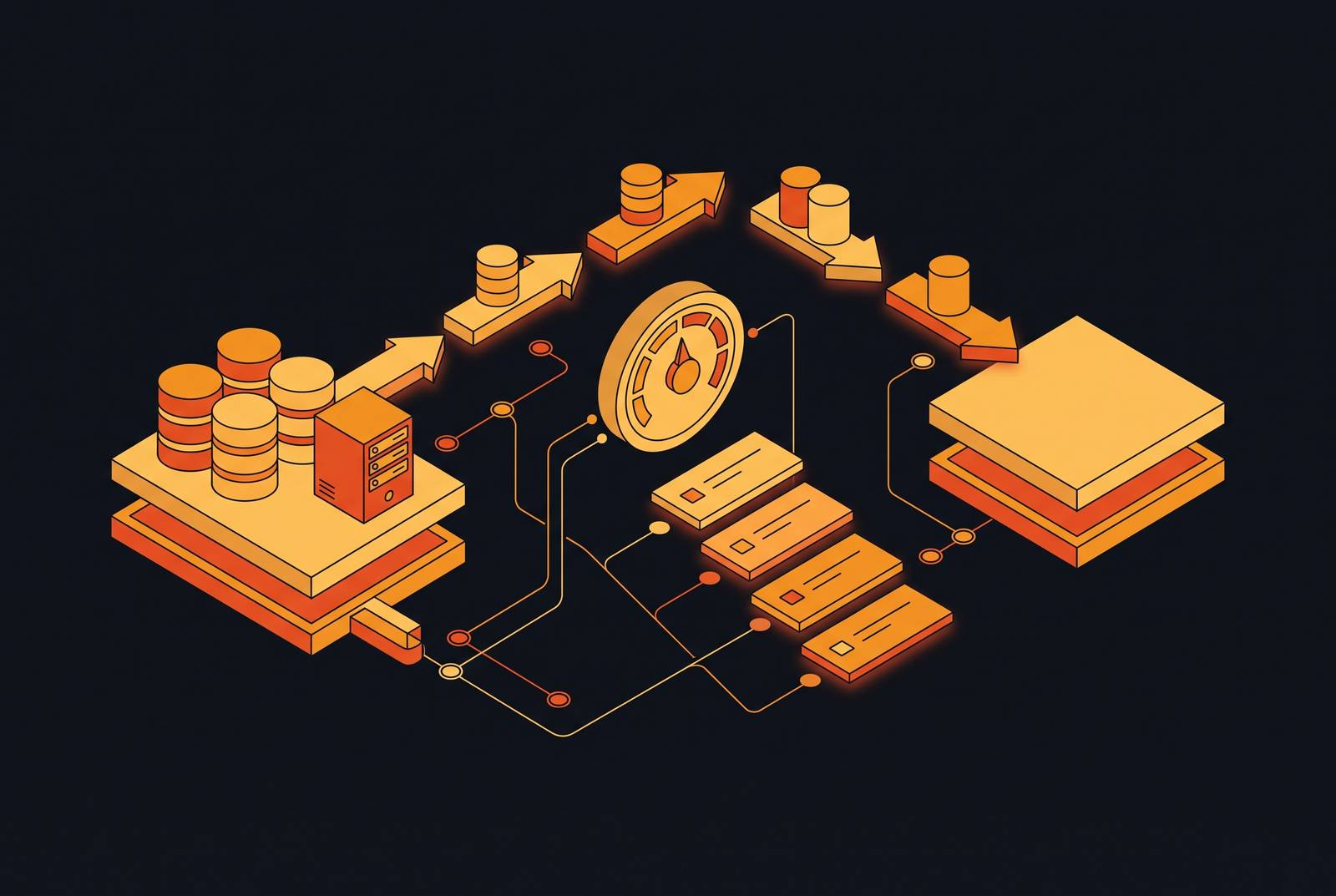
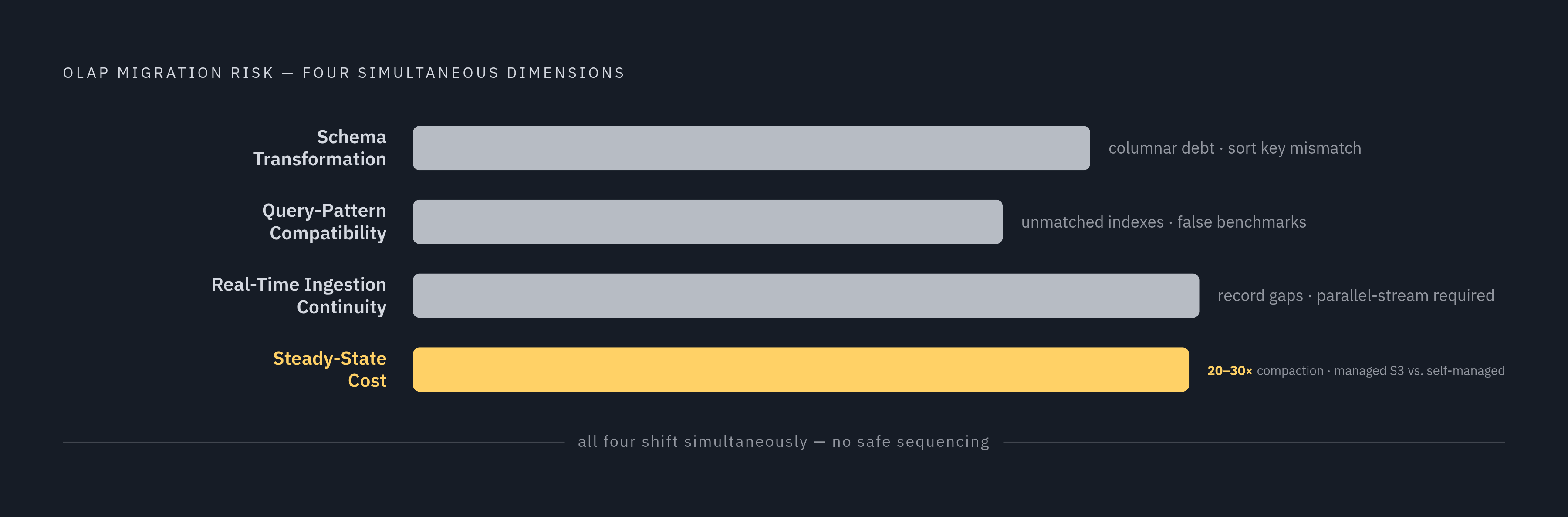
Standard cloud migration checklists apply the same risk categories no matter what's being moved: downtime, data loss in transit, security exposure, application compatibility. Those four categories work fine if the database on the other end is transactional. They fall apart the moment the database is OLAP, because the checklist assumes a database move is a scheduling and inventory problem: pack up the tables, ship them, unpack them, check the boxes. Ayomide and Brooks's risk-aware cloud migration framework (2026) gets closer to the real issue: risk decisions stay scattered across security, data, legal, architecture, and business teams because the framework never asks these teams to reckon with schema, platform, analytical use, and data ownership changing all at once. An OLAP migration does all four at the same time, and a checklist built for row-by-row data movement has nothing to say about any of them. What's needed is a different scoring instrument built around the failure modes that are actually specific to columnar, analytical systems: how the schema gets transformed, whether query patterns survive the move, whether ingestion keeps up in real time, and what the target architecture costs to run once the migration team has gone home. Each one gets its own weight below, and if you leave it unmeasured, it only gets worse.
Schema transformation risk: why columnar debt compounds during migration
Schema mismatch is the single biggest driver of OLAP-specific migration failure, and the reason is structural. Columnar engines are built around how data gets queried. A schema that gets carried over from the source system without being redesigned for the target doesn't just migrate poorly. It locks in the wrong access pattern permanently, because once a dashboard or a reporting pipeline is built on top of that schema, undoing it means rebuilding everything downstream of it too.
The asymmetry here matters more than it might first appear. In a transactional (OLTP) migration, a schema error tends to announce itself fast: an application throws an error, a form fails to save, someone notices within hours. In an OLAP migration, a schema error appears as a wrong number on a dashboard, weeks later, after the people who ran the migration have moved on to the next project. Take a numeric field that silently converts from dollars to cents: it loads without complaint. Hakuna Matata's analysis of migration failures documents exactly this pattern: the data arrives, the pipeline runs clean, and the corruption only becomes visible once someone questions why a revenue chart looks off by two orders of magnitude. By the time anyone traces it back to the migration, it has already propagated through every downstream metric that touched that column.
The cost consequence raises the stakes of slow detection. A query that scans an unnormalized, wide table, hundreds of columns, tens of millions of rows, instead of hitting a properly designed fact table with pre-filtered columns, can scan 10 to 50 times more data per run, and that cost is not one-time. It repeats on every single query against that table, for as long as the schema stays uncorrected. Schema debt in OLAP doesn't fail the migration. It taxes every query that runs against the result, forever, until someone goes back and fixes it.
A risk score needs to catch this before go-live, not after. That means looking at column count and width in the source schema (a wide, flat table is a warning sign on its own), checking whether the source was ever built as a star schema or whether it's a flat export straight out of a transactional system, comparing sort key and partitioning schemes between source and target engine, and watching closely for data type mismatches, the dollars-to-cents kind of error that loads cleanly and breaks silently. Stored procedures and proprietary SQL syntax deserve their own line item too, because you'll run into this constantly in financial services migrations off legacy engines. Lumenalta's database migration checklist (updated 2026) correctly flags schema incompatibility as something that needs mapping and validation before migration starts, but it stops short of naming what actually makes OLAP schema mapping harder than OLTP schema mapping: cardinality, sort key semantics, partition granularity. That's where the real risk lives, so if a score doesn't name them, it isn't measuring the right thing.
Query-pattern compatibility risk: why pre-migration benchmarks on the wrong queries are worse than no benchmarks
A schema can transform cleanly and the migration can still fail, because a correct schema doesn't guarantee the right queries run fast against it. The gap is visible in what gets tested, not whether testing happened. A pre-migration benchmark that only runs simple aggregate queries will tell you nothing about how the target engine handles the join-heavy, high-cardinality filter queries that make up most of actual production traffic. A benchmark on the wrong query shapes is worse than no benchmark at all, because it hands the migration team false confidence right before cutover.
This problem is sharper in OLAP than in transactional systems because OLAP engines aren't interchangeable at the index level the way relational databases often are. Engines like Apache Pinot use Star-Tree indexes that can cut query time on aggregations over billions of rows from seconds down to milliseconds. If you move off an engine built around that kind of index without replicating an equivalent structure on the target, you lose the performance guarantee that justified the original architecture choice. Nobody decided to give up that performance. It just wasn't tested for, so nobody noticed it was gone until production traffic hit the new system.
Ayomide and Brooks argue that migration pace should scale with what risk reduction has actually been observed, not with whether a review happened to clear a checkpoint on the calendar. Applied here, that principle draws a clean line: a latency benchmark run against a representative sample of real production queries is an observable risk-reduction gate. A benchmark run against a synthetic workload is just a calendar event dressed up as due diligence, measuring whether a benchmark got run rather than what actually matters.
A proper risk score needs to treat query-pattern coverage as its own dimension. Catalog the query shapes that actually run in production: point lookups, full scans, aggregations over high-cardinality dimensions, multi-table joins, time-range filters. You map each shape to whichever index type on the source engine serves it now. Then, for each shape, check whether the target engine has an equivalent index type, and whether that index has actually been configured, not just theoretically available. The score should rise with every production query shape that has no mapped equivalent on the target. Latency regression caused by this gap rarely appears in pre-migration testing. It becomes visible when production concurrency and data volume hit, conditions most test environments never come close to replicating.
Real-time ingestion continuity risk: the failure vector that compounds during the migration window itself
Batch data warehouses can pause. Real-time OLAP systems can't, and that one difference creates a risk category generic migration frameworks have no language for. The source system keeps receiving streaming data for the entire duration of the migration window. Any gap in ingestion continuity on the target side during that window doesn't just delay a sync. It produces a permanent record gap, data that was never captured anywhere and can't be recovered after the fact.
The structural difficulty runs deeper than "keep both systems running." Engines like Apache Druid ingest natively from Kafka and Kinesis at sub-second latency, and that ingestion topology is tightly bound to the engine's own internal partitioning and rollup logic. Moving to a different target means re-specifying rollup granularity, segment structure, and late-arrival handling, all from scratch, because none of that logic transfers automatically. Change data capture tools built for transactional systems, Estuary Flow and Oracle GoldenGate among them, operate at the row level. Streaming OLAP ingestion operates at the event-stream level, with ordering and deduplication guarantees that work on entirely different assumptions. The category of tool doesn't carry over. CDC isn't wrong for this job; it's built for a different job.
Hakuna Matata's analysis documents a global e-commerce client that pulled off a twelve-minute downtime window migrating a twelve-terabyte database using CDC, a genuinely strong result. But that was a relational workload, where pausing writes for twelve minutes is disruptive but survivable. The equivalent problem for a real-time OLAP pipeline isn't minimizing a pause. You have to run two parallel ingestion streams at once and confirm, aggregate by aggregate, that the target produces identical numbers before anyone flips the switch to cut over.
Scoring this risk means asking a specific set of questions up front. What's the ingestion source type: file-based batch ingestion is low risk, Kafka or Kinesis streaming with sub-second SLAs is high risk. Does the source engine materialize rollups on ingestion, and if so, has the target been built to replicate that exact logic, or will historical aggregates start to drift the moment the new system comes online? What's the business's actual tolerance for a gap in real-time visibility, measured in seconds, minutes, or hours, since that number decides whether a parallel-ingest strategy is required or a brief pause is acceptable? And if the target pipeline starts diverging mid-cutover, can the source still be re-designated as primary without losing data, or has it already been degraded to read-only with no way back?
Steady-state cost risk: the architectural penalty that generic frameworks treat as a post-migration concern
Most risk scores stop measuring the moment the migration finishes. That's a mistake, because the most expensive risk in an OLAP migration often doesn't appear until well after go-live: the ongoing cost delta created when a high-scan workload lands on an architecture that routes every single query through object storage.
The compaction layer is where this cost stops behaving in a straight line. Hands-on research in this area finds compaction costs running 20 to 30 times higher with managed S3-table services than with self-managed approaches, and on top of that, compaction delays make query performance degrade in a way that won't resolve on its own. A database can look perfectly reasonable on compute cost in a pre-migration estimate, but still end up costing several multiples of that in I/O and transfer charges once it handles real production scan volumes. Nobody budgeted for this because nobody modeled it. The estimate measured compute. It never measured what happens when every query has to round-trip through object storage at scale.
A cost dimension in a risk score needs to account for query scan volume per day, because total bytes scanned drives the API request load against object storage. It needs to account for compaction frequency and what that costs at the data volume the migration is actually targeting. It needs to look at egress topology: does the target keep hot data in a cache layer, or does every query cold-read from object storage every time? And it needs to weigh the pricing model itself. Per-query pricing punishes the exploratory, high-frequency scan patterns that define OLAP workloads by nature. A compute-hour model that doesn't meter individual queries removes that compounding effect.
The architectural fix is specific: separate compute from storage. An architecture that separates compute from storage while keeping hot data in a local cache layer, NVMe rather than repeated S3 round-trips, eliminates the compounding cost without giving up S3's durability. That's a concrete property to check for in any target candidate.
Agentic query risk: the failure vector that doesn't exist in pre-2024 migration frameworks
If a risk framework was built before AI agents became a regular user of production databases, it's missing a failure vector that's already live. Agents probe schemas recursively. They generate query shapes that don't repeat the same way twice. They issue introspection calls at a rate and in a pattern that no pre-migration load test was built to anticipate, because agents weren't part of load-test design.
A human analyst and an agent differ in kind here, not in degree. An analyst queries a schema they already understand, one built on institutional knowledge accumulated over months. An agent operating through text-to-SQL re-derives joins, grain, and metric logic from scratch on every single invocation. Asking the same business question twice can make the agent generate two different query shapes in response, so results come back inconsistent against a migrated schema that was never wrapped in a semantic layer to begin with. MCP (Model Context Protocol), introduced by Anthropic in late 2024, has become a standard interface for agents to interact with external tools and data, and MCP server implementations already exist for multiple OLAP engines. Post-migration, agents will have structured access so they can describe and query the schema directly. A migration risk score needs to check, as a specific line item, whether the target engine has a production-grade MCP integration, because that integration determines how agents will actually behave against the new system from day one.
Without a governed semantic layer sitting on top of the schema, metrics defined in the source system don't carry over to the target automatically. Agents querying the migrated schema will re-derive those metrics on their own, and if the underlying schema transformation was incomplete, the re-derivation can be wrong in ways nobody catches until the numbers are already in a report.
There's an accountability dimension here too, and it can't be an afterthought. Agents issuing queries autonomously against a production OLAP database need to be logged in full: every query, every schema introspection call. Incomplete logging breaks the audit trail the moment anyone needs to trace a wrong number back to its source. A migration risk score that doesn't account for agentic traffic is scoring the database that existed before 2024, not the one being handed to production users now.