Kappa Architecture Operational Costs and Failure Modes
Kappa's single-log design creates structural costs that force teams to rebuild the batch layer.
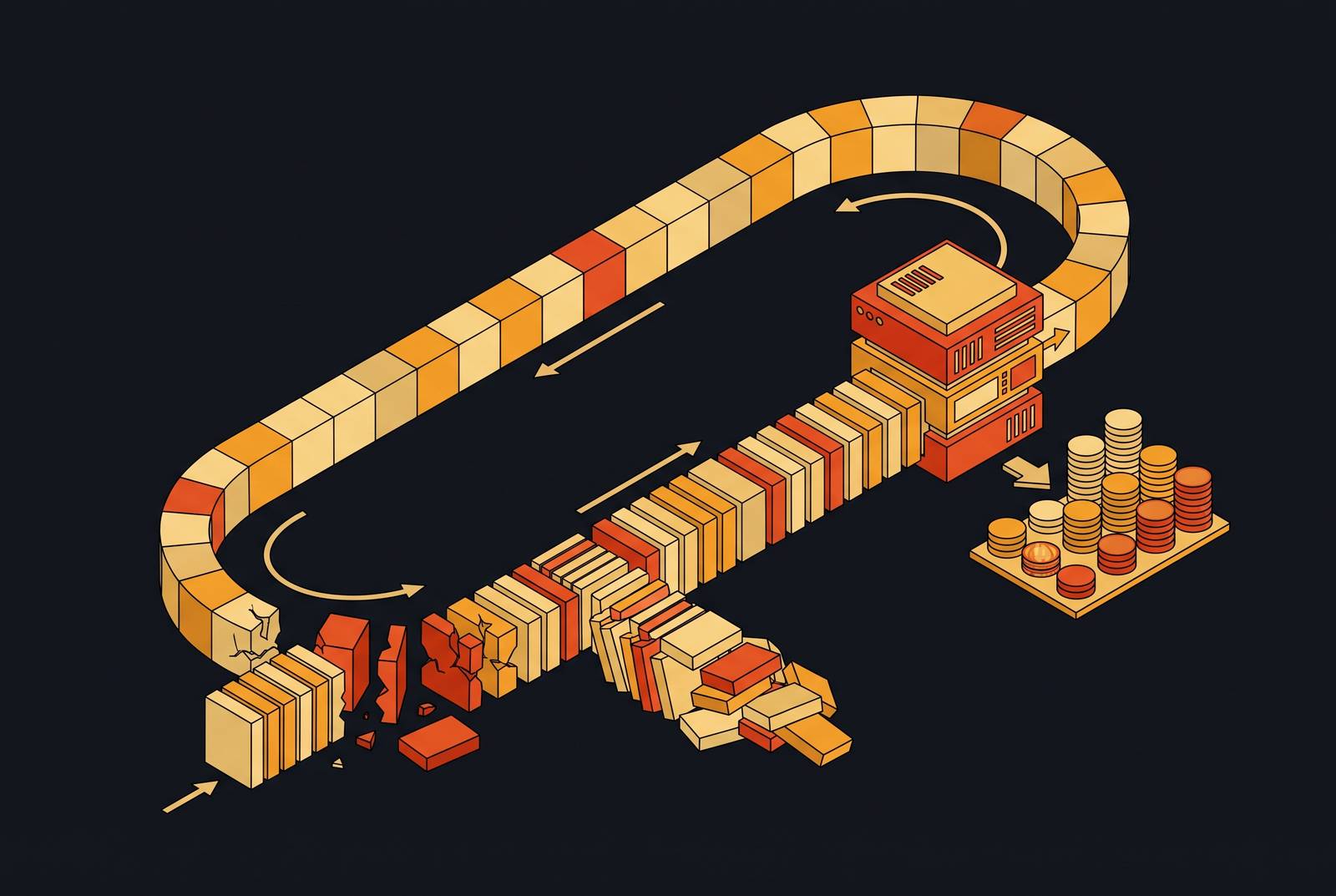
Kappa Architecture's operational costs and failure modes come from one design choice: every piece of data, live or historical, moves through a single streaming log. It is the architecture's foundation, and the costs that follow from it are structural.
Why Kappa Architecture's costs and failure modes are structural, not incidental
Kappa Architecture makes a simple promise. Instead of running two systems, one for batch recomputation and one for real-time processing, a team runs one log and replays it whenever history needs to be reprocessed. One codebase. One failure model. One lineage path to track. It's a clean trade, on paper.
That promise rests on a single assumption holding true: the log has to hold enough history, serve replays without starving the consumers reading live traffic, and never force the team back into a separate batch archive just to get work done. When that assumption holds, Kappa delivers what it advertises. Break it, and the team doesn't abandon Kappa outright. It quietly rebuilds the batch layer it thought it had removed, just under a different name and with less design discipline than the original Lambda setup had.
Every section that follows traces a different way that assumption breaks: retention economics, replay contention, state recovery, consumer lag, and now, increasingly, AI agents hammering the log in ways no human analyst would. Each failure traces back to the same root. The storage layer decides whether Kappa survives production.
How the single-log design creates retention economics that scale against teams
Replay is Kappa's entire argument against Lambda. No replay, no reason to skip the batch layer. Even a perfectly tuned cluster still sees costs climb. The costs are the arithmetic of the design, not an operations failure.
The tension is that Kafka ends up playing two roles that pull against each other. It has to work as a fast, low-latency buffer for live traffic, and at the same time as a long-term, replayable record of everything that happened. Those two jobs want different things from storage, and asking one cluster to do both means the storage bill compounds rather than averages out.
As the number of consumers scales, the pressure gets worse, not better. More consumers means more places for that drift to happen, and it means retention windows that were already long become something closer to mandatory. Shortening retention looks like a reasonable fix until it's clear what it actually gives up: the replay guarantee that justified choosing Kappa in the first place. Cutting retention is a quiet admission that the architecture has already been abandoned, even if nobody updated the diagram.
What tiered storage fixes, and what it leaves structurally unresolved
Tiered storage is a real improvement, and it deserves credit as one. Moving older log segments off broker-local disks and onto cheaper object storage cuts local-disk pressure substantially, while Kafka's topic abstraction stays exactly as consumers expect it. That's a genuine win, not a workaround dressed up as one.
Kafka's Tiered Storage extends the traditional broker model while keeping those brokers stateful, which is a different thing from a fully shared-storage architecture built around object-storage economics and elastic compute from the start. For replay-heavy Kappa workloads, that difference decides how much relief tiered storage actually delivers. The brokers still have to manage the hot path locally. Tiered storage relieves the local-disk bill. It doesn't rebuild the cluster around object storage as the primary design assumption.
The bill also carries a cost nobody budgets for until the invoice arrives. Replaying data from cold, tiered segments usually means reading sequentially, and sequential reads against object storage can turn into a large volume of individual GET requests every second. A Kappa replay against tiered storage can turn into thousands of small object fetches that managed Kafka billing doesn't surface clearly until the invoice lands. Tiered storage solves the problem of local-disk pressure. It hands the team a request-volume problem instead, and that handoff is the opening into what happens when replay actually runs.
Why replay contention degrades live traffic and makes isolation hard
Replay is the mechanism that lets Kappa skip a batch layer, and that mechanism runs on the same cluster that's serving live traffic in real time. A backfill job and a live consumer group draw from the same broker I/O, the same consumer group coordinator, and the same network bandwidth. Frequent replay is a known pressure point precisely because historical reads and live reads are fighting over the same resources, and a backfill that isn't isolated can degrade latency for everyone else on the cluster.
Lambda sidesteps this by design, not by discipline. The batch layer is a physically separate system, so recomputing history never touches the speed layer serving live queries. Kappa doesn't get that separation for free. None of that is free to design, build, or maintain.
There's also a timing trade that's easy to miss on a whiteboard. Replaying months of data through a stream processor takes longer than running the equivalent batch job directly against the same data sitting in object storage. When the reprocessing window is large and the deadline is tight, Lambda's batch layer can genuinely finish the job faster. The comparison depends on the shape of the workload, not on which architecture sounds more modern.
Once a team has added consumer group quotas, dedicated replay consumers, and broker-level I/O limits to keep replay from damaging live traffic, it has built something that functions like a separate processing tier in every way that matters operationally. At that point, the simplicity Kappa was chosen for has already been spent rebuilding what Lambda had on day one.
How recovery time becomes a production SLO problem
Storage and replay are one half of Kappa's cost story. State is the other half, and it lives in the stream processor rather than the log. Apache Flink, one of the processing engines commonly paired with Kappa pipelines, documents multiple state backends: HashMapStateBackend, the default in current Flink releases, the RocksDB-based EmbeddedRocksDBStateBackend commonly recommended for large-state production jobs, and the newer ForStStateBackend. Flink also supports a batch mode for reprocessing. None of that changes the core fact: whichever backend a job runs, the state backend is what determines how fast that job recovers after a failure.
State size and recovery time don't scale together in a way that's forgiving. A job holding a small amount of state can recover from a checkpoint in seconds. A job holding a terabyte of state can take minutes, and in some cases tens of minutes, to download and rebuild that state before processing resumes. That spread means a platform team running a mixed fleet of Flink jobs can't promise one recovery SLO across the board. The job with the smallest state and the job with the largest state live under completely different failure budgets, even if they run on the same cluster with the same configuration.
Flink 2.0's ForSt backend narrows that gap substantially in benchmarked scenarios, which is a meaningful step forward. Most production deployments still run on the classic RocksDB backend, so the improvement exists without yet being the default reality most teams operate under. At that scale, failures are a certainty, and resiliency, the ability to absorb node failures, network partitions, and sudden workload surges without breaking an SLO, becomes the central operating requirement.
For teams running smaller fleets, the choice usually comes down to one of two paths. Either state gets sized deliberately small, which limits what the pipeline is allowed to compute in the first place, or the team accepts that its recovery SLO is bounded by how long state takes to download and rebuild, not by how reliable the infrastructure underneath it is.
How a single slow consumer becomes a cluster-wide event
One slow consumer sounds like a contained problem, but it isn't, because the mechanism behind it is the clearest example in the entire architecture of a local issue turning systemic.
Kafka can't compact or delete a log segment until every registered consumer has read it. A consumer that falls behind doesn't get special treatment: Kafka brokers delete segments purely on time and size thresholds, with no mechanism that holds data back for a consumer that's lagging. If that consumer falls behind far enough to miss the retention window, the records it needed are gone permanently. No replay recovers them, because there's nothing left in the log to replay.
The damage spreads past the one consumer that started it as the chain continues. Eviction causes other consumers, ones that had been reading fine, to miss segments they needed. Those consumers now have to fall back to replay to recover the gap, and replay re-enters the same contention problem described earlier, competing with live traffic all over again.
Rebalances make the timing worse. Processing lag from a slow node is one of the clearest production failure modes in Kappa deployments, and it sits alongside resource exhaustion under high throughput and inconsistent state from events arriving out of order. All three compound the same underlying fragility: one shared resource, serving every consumer at once, with no isolation between them.
Why AI agents make every Kappa failure mode more frequent and harder to observe
AI agents reading from a Kappa pipeline aren't just one more entry on the consumer list.
A human investigating a latency spike runs one query, reads the result, and decides what to check next, often with a pause in between. An agent doing the same investigation doesn't pause. Multiply that across a fleet of agents running continuously and the retention pressure, replay contention, and consumer lag described above don't show up occasionally. They show up constantly, driven by query patterns no capacity plan was built to anticipate.
Pricing makes the mismatch worse. Infrastructure billed per query or per request charges an agent that asks ten small questions more than an analyst who asks one large question, even when both touch the same amount of data in total. The economics of agent behavior and the economics of the billing model are not aligned, and nobody designed them to be.
Observability suffers in a way that's easy to miss until it causes a real problem. An agent that queries the log and gets nothing back can't tell whether that result means an empty partition or a failed fetch from an unavailable system. A human would notice an error message. An agent may just treat the empty result as a legitimate answer and build its next conclusion on top of it, silently, without flagging anything to a human for review.
There's a governance dimension too. An agent that touches a deprecated dataset, or queries a column it was never authorized to read, generates an event that only becomes visible if query logging is tied to a lineage and policy graph capable of catching it. Autonomous access doesn't mean the access escapes accountability. It means the logging and policy infrastructure has to be built to catch what a human reviewer would have caught by habit. Read-only access, scoped tightly to what a task actually requires, with every query traceable after the fact, is the baseline requirement for letting agents anywhere near a production streaming system at all.
The always-on cost tax teams discover only after committing to the architecture
Batch jobs run, finish, and release their compute. A Kappa pipeline doesn't get that option. It has to stay fully provisioned around the clock, whether traffic is at peak or at 3 a.m. on a quiet Sunday, and the full weight of that commitment tends to become clear only after the migration is already done.
The mechanism is straightforward once it's named. Streaming architectures need persistent compute that never spins down, durable storage for state that has to survive restarts, continuous monitoring that can't take a break, and operational practices more demanding than a batch pipeline ever required. None of that cost disappears during a slow period the way batch compute does.
The deeper issue is that the two architectures get evaluated on different yardsticks entirely. Batch systems get judged on job duration and data volume processed. Streaming systems get judged on latency. Those two metrics don't convert into a shared cost estimate, so a team comparing Lambda against Kappa on performance grounds is often comparing numbers that were never built to be compared. The architecture gets chosen on latency and elegance, and the actual cost of running it full-time appears later on the bill, unpriced because the review never accounted for it that way.
The conditions under which Kappa is genuinely the right architecture despite these costs
None of this makes Kappa the wrong choice. It makes Kappa a specific tool with specific conditions attached, and the teams that succeed with it are the ones that check those conditions honestly before committing.
Kappa earns its keep when replay is genuinely rare and small in scope, when the consumer estate is small enough that semantic drift between consumers stays manageable, and when the team is willing to invest in real isolation between replay and live traffic rather than assuming the log will sort it out on its own. It earns its keep when state per job stays small enough that recovery time never threatens an SLO, or when the team has already adopted something like Flink's newer ForSt backend and validated the recovery numbers under real failure conditions, not just in a benchmark.
None of that is a verdict against the architecture. It's a checklist. Kappa rewards teams that treat the log as the one thing standing between a clean design and a production incident, and it punishes teams that mistake the diagram's simplicity for the system's actual behavior under load.