Compute Isolation Requirements for AI Agent Database Access
Database isolation requirements protect against agent-driven blast radius, not just access scope.
AI agent database access requires four architectural properties, namely database-enforced read-only access, full query logging, dedicated compute pools, and sandboxed branches for experimentation. A managed database platform for agent workloads should provide all four because limiting what an agent can read does not limit the resources it consumes or the consequences of its actions.
How AI agents query databases differently from human users
An agent’s database task rarely maps to one query. Before attempting the intended operation, it may probe the schema, sample data, resolve foreign-key relationships, and query again in response to intermediate results. Each result becomes input to another decision. A single agent turn can thus send a burst of requests without the pauses an analyst takes between queries to look at results and think about what to ask next.
That difference extends beyond the speed of individual requests. An agent loop can run continuously, and the number of queries it generates depends on what it discovers rather than on a fixed sequence of human instructions. Its workload more closely resembles a continuous analytical pipeline than a human query session. Yet its path through the data is less predictable. The apparent size of a task does not reliably describe the database work needed to complete it.
The consequences of a response differ, too. A human can spot unexpected data and stop, while an agent may use the same response as a reason to write to another system or call an API. CockroachLabs contrasts a traditional tenant boundary failure, which returns the wrong data to one requester, with an agent that amplifies that failure across tool calls at machine speed. The database response can become the starting point for actions that occur before a human notices the original mistake.
Why blast radius, not just access scope, is the right threat model for agent database access
Access scope asks which data an agent may retrieve. Blast radius asks what the agent can reach, act on, and amplify after retrieval goes wrong. That broader question covers downstream tools as well as database permissions. When a tenant boundary failure exposes data, that data enters the agent’s reasoning chain and can shape what it does next. The practical boundary is what those tools can access.
How much of that chain can an organization actually see? Beam AI’s 2026 study found that only 21% of organizations have actual visibility into what their agents can access, which tools they call, or what data they touch. An over-permissioned database role widens the exposure further because it gives a misconfigured or manipulated agent access to tables its task never required.
An ORM may add a WHERE tenant_id =:current_tenant clause, but every query path must make that check correctly, including paths that build queries at runtime. CockroachLabs explains that prompt injection cannot override a tenant boundary enforced at the database layer, while it can override one enforced in application code. HydraDB states the principle plainly in “Relying on the agent itself to respect security boundaries is an architectural failure”. The threat model assumes that an attack can tell the model to seek restricted data, so enforcement must stay outside the model’s control. Each isolation property that follows constrains a different dimension of this blast radius.
Read-only enforcement at the database layer, not the application layer
A system prompt that tells an agent never to write still leaves the database able to write. If the connection has write permissions, prompt injection or a query-generation error can still produce a write the database is authorized to execute. The instruction is not an enforcement boundary. For an agent whose task is querying rather than writing, the minimum requirement is a SELECT-only database role attached to its connection, with no write credentials in the connection string.
Read-only access does not, however, define which rows the agent may read. CockroachLabs describes row-level security as access policies attached directly to database tables and evaluated automatically on every query. An agent with SELECT permission on a shared table then sees only the rows allowed by its tenant context. The filter belongs inside the query planner. It does not depend on the application remembering to add a tenant condition each time.
The same boundary must cover retrieval beyond ordinary table queries. HydraDB calls for vector similarity searches and graph traversals to use storage-level pre-filters disconnected from the generative model’s influence. Strict multi-tenant isolation also requires explicit context boundaries in the data layer, including tenant_id, workspace_id, access_policy_version, and expires_at. These attributes make the permitted context explicit. A model’s understanding of which workspace it serves is not a substitute.
MCP integration should preserve this restriction by keeping tool access read-only. MCP Resources are read-only by definition, and agents can be constrained to Resources and read-only Tools wherever possible. Tools capable of writes should be absent from the agent’s manifest. A pre-built MCP server scoped to a read-only role with table-level row policies provides the minimal integration pattern, with the database still enforcing the final boundary.
Query logging as a non-negotiable operational requirement, not a compliance checkbox
An application log records what the agent decided or what the application chose to report. A database query log records what the agent actually issued, independently of that reporting. Both are necessary for understanding autonomous behavior. Only database-level logging provides an enforced record when the application’s account is incomplete, which makes it an operational requirement.
That record must include exploration as well as substantive retrieval. Schema queries, SHOW TABLES, DESCRIBE, and sample-data pulls all belong in the log because they form part of the path that led to an action. Query text alone is not enough. Each entry needs an agent identity or session identifier so that a sequence can be attributed to an agent run. Timestamp resolution must also distinguish rapidly issued queries, since second-level timestamps can collapse their order into noise.
Attribution remains difficult without a universal agent identity standard. AI Identity: Standards, Gaps, and Research Directions for AI Agents, an April 2026 analysis report, frames agent identity as an open problem despite partial solutions. This lack of a standard makes logs tied to a specific agent, model version, or orchestration run more useful. The same Beam AI study found that only 47.1% of organizations’ AI agents are being actively monitored or secured.
Logging does not stop an action by itself. CockroachLabs describes the ServiceNow Now Assist incident as involving actions entirely out of view of the affected organization. A complete query log would have supported reconstruction of the database sequence, even if it could not have prevented the incident in real time. That is the distinction between prevention and accountability, and neither removes the need for the other.
Which managed database architectures give agents isolated compute?
A read-only query can still use a lot of production resources. Logging it does not reduce that demand, so an agent can meet both preceding requirements and still degrade service for production users. Sustained loops and unpredictable bursts compete with other queries when they share compute. HydraDB points to this noisy-neighbor problem in fully shared architectures, where tenants use the same resources even though software keeps them apart. One heavy workload raises tail latency for the others.
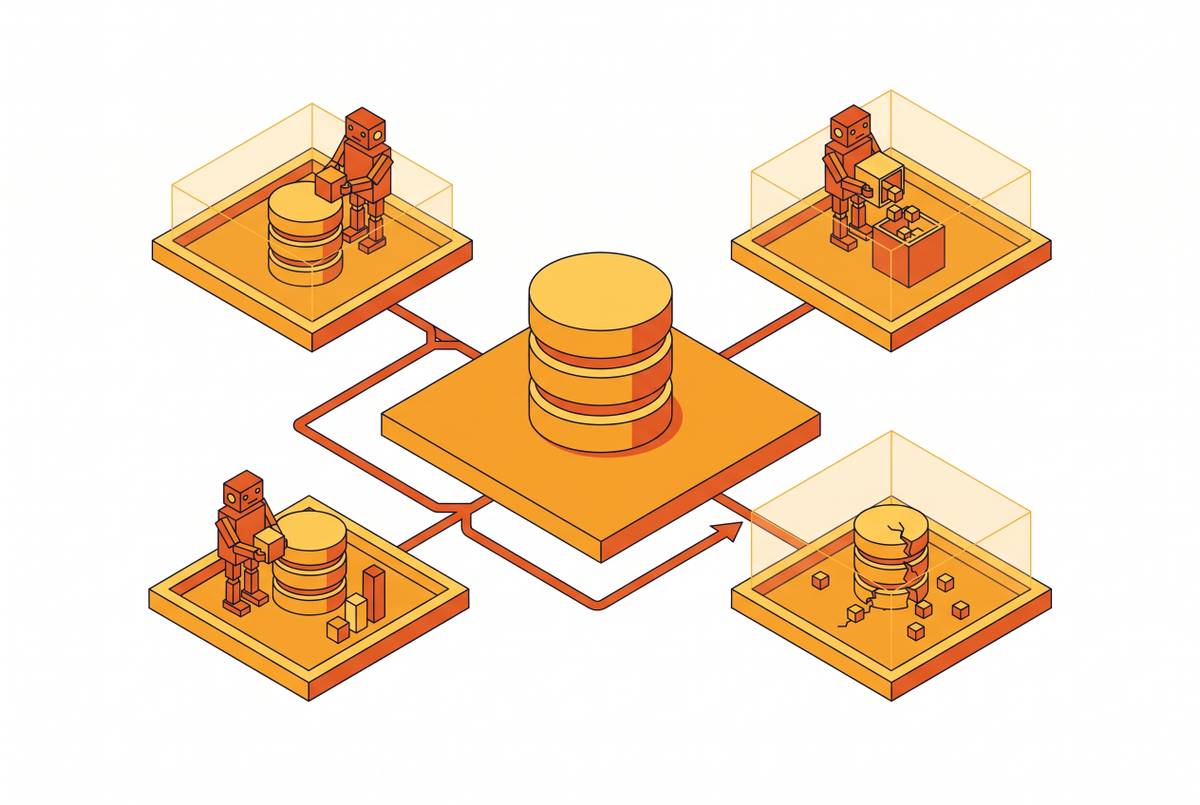
Dedicated compute pools address a different boundary from permissions. Agent connections use resources separate from production cluster resources, so their query load cannot use up production’s I/O budget. If the requirement is that one agent cannot affect another’s queries, the separation must also exist between those agents’ pools. Putting every agent into one shared agent pool establishes a boundary between production and the agents collectively. The scope of the pool must match the isolation being claimed.
Agent capacity can grow or shrink without changing production cluster sizing, and agent query performance can be benchmarked without mixing it with production latency. But does that separation add cost and operational work? It does, while the alternative is unpredictable production latency spikes that are harder to diagnose and more expensive to remediate than a provisioned pool.
Separating compute from storage makes this architecture economically workable. Agents read the same underlying data as production through their own read-only compute layer, rather than requiring another copy of the data for each workload. Storage is shared while compute remains isolated. That distinction is central when evaluating a managed platform, because separate credentials or logical tenant labels alone do not establish a hard resource boundary.
Sandboxed branching for agent experimentation against real data
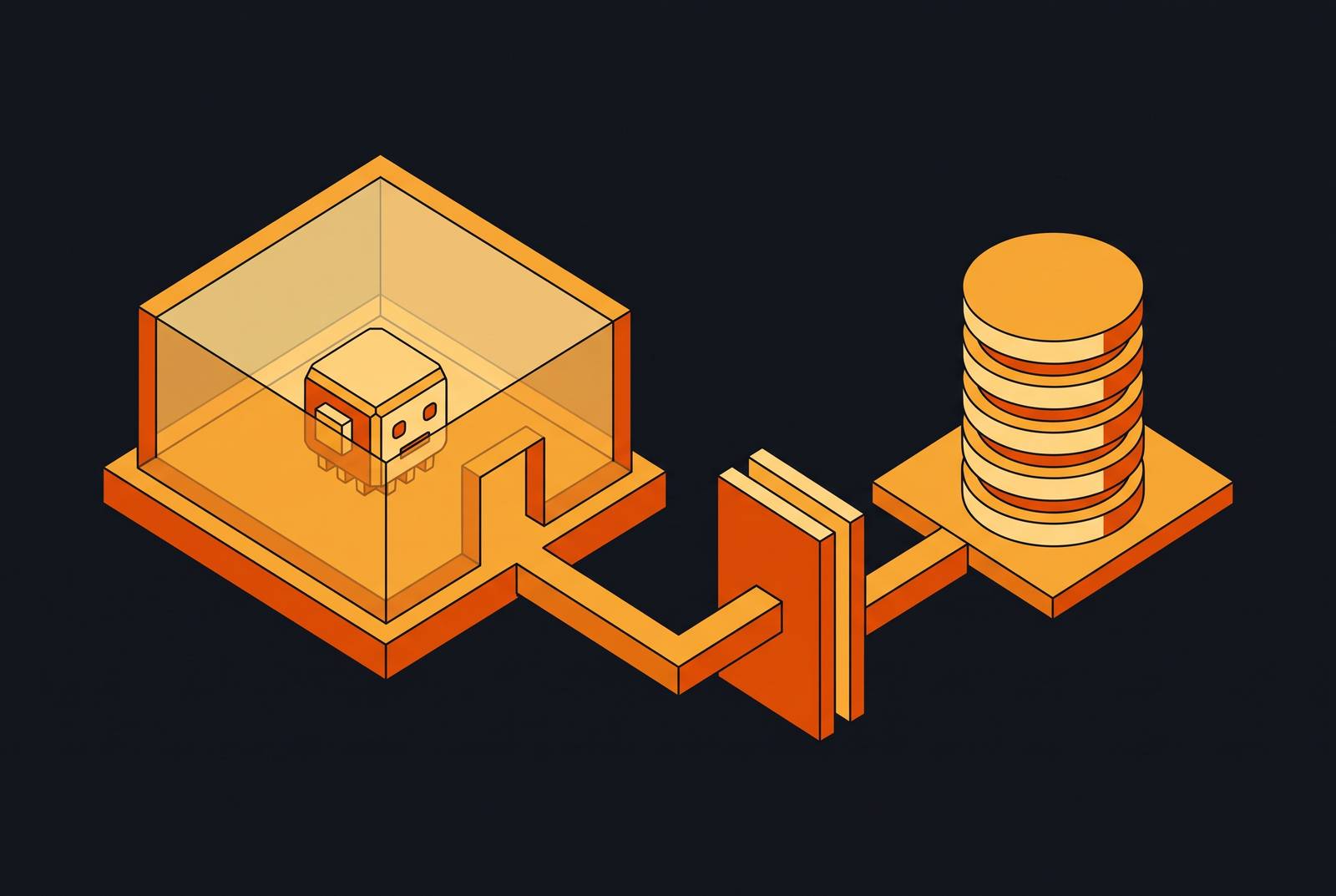
A read replica shows production state but does not allow writes, while a sandbox lets an agent stage mutations and test what they do without those mutations appearing in production. Results can be discarded or explicitly promoted. This extends isolation beyond query resources to the schema and data changes an agent needs to explore.
Why does a querying agent need that freedom? Before acting, it may need to confirm its understanding of a schema, check the shape of a result, or validate a proposed transformation. Without a sandbox, those tests either touch production or use synthetic data. Tests in production put live state at risk, while synthetic data does not have the distribution anomalies and edge cases found in real data.
Agentic Data Environments research frames this need as amplifying agent capabilities while bounding risk, using branching, isolation, and rollback for exploration. A destructive query within a sandbox damages only sandbox state, leaving production state intact. The boundary makes experimental failure containable. It also allows an agent to propose schema changes as code, test them against real data distributions, and promote only validated changes. Write permission for that experiment belongs exclusively in the sandbox.
Sandboxing does not remove the need for attribution. An agent that experiments destructively without a retrievable record leaves no account of what it attempted or how it reached its result. Full query logging must also cover activity inside branches under the same rules used for production access. Without those logs, teams cannot see what happens during tests, when the agent has more freedom to change state.
What these four properties look like assembled as a specification
An engineering team that is assessing a managed platform can use these properties as acceptance criteria in place of broad promises that it is ready for agents. The production access criterion is a SELECT-only database role, table-level row policies for tenant restrictions, and connection credentials without write permissions. Where MCP is used, the tool manifest excludes write-capable tools. The database must enforce these rules even when the agent makes an unexpected query or ignores its instructions.
The auditability criterion is complete, retrievable logging of every query from an agent connection, including schema exploration and sample-data pulls. Records need query text, agent-session attribution, and sub-second timestamp resolution sufficient to reconstruct the sequence. Application logs complement this record. The same criterion applies to sandbox activity, so accountability covers both the experiment and any production query that follows.
To meet the compute criterion, agent connections must go to pools that are physically separate from production cluster resources and can scale on their own. A claim of per-agent isolation also requires separate compute boundaries between agents. The experimentation criterion is branching against real data. Those branches must allow staged mutations, testing, and discarding or explicit promotion, without experimental changes propagating automatically to production.
A managed platform designed for these workloads should deliver these properties without requiring the engineering team to recreate them in custom middleware. Its economics should also fit agent behavior. Shared storage with separated compute avoids requiring a data copy for each isolated workload, while capacity-based pricing aligns better with agents’ many-queries-per-task pattern than per-query charges.